


Paige Jardine: Finding her way back to what matters

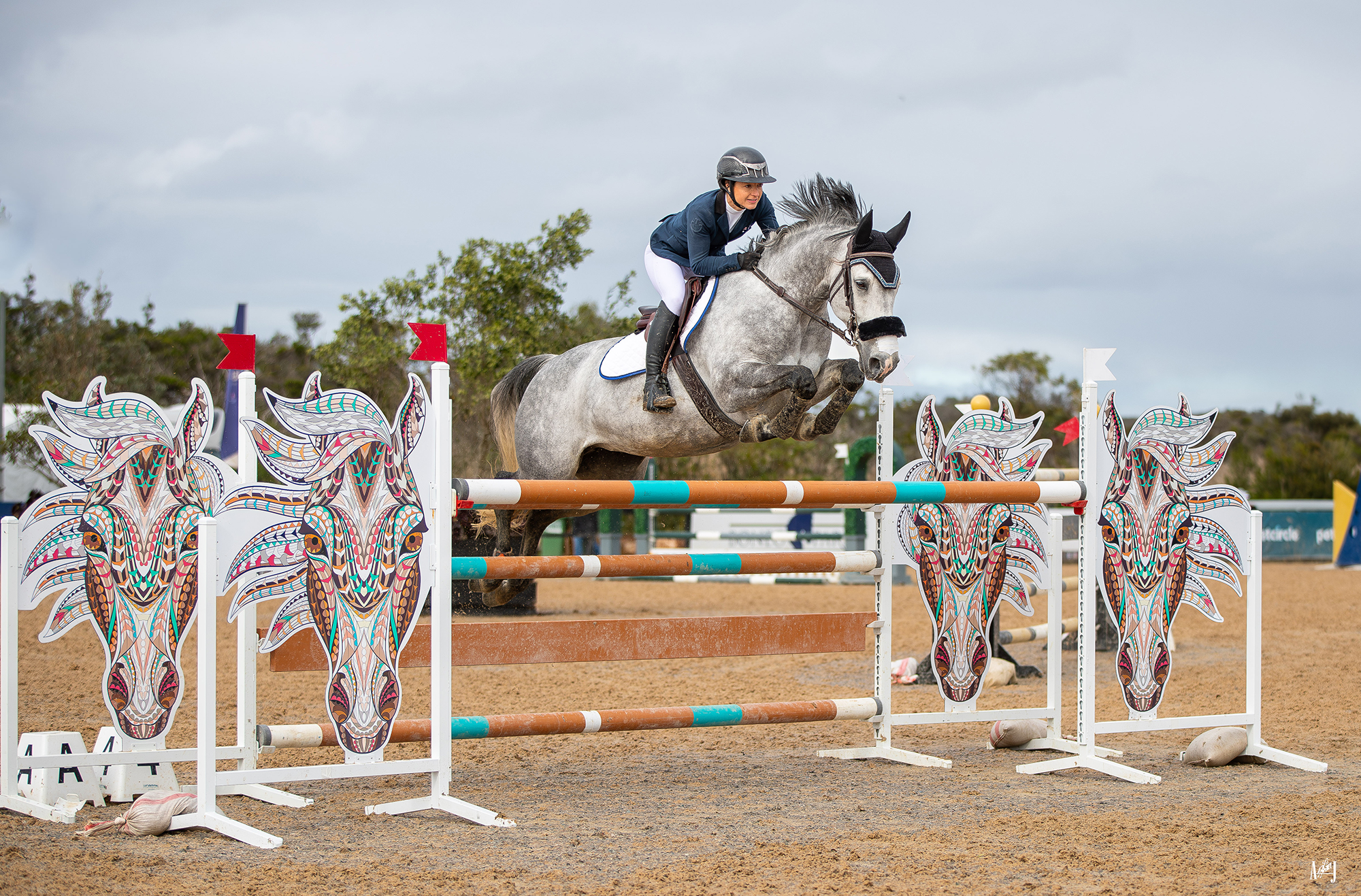
Above: Paige Jardine and Yalambi’s Narnia at the 2025 Australian Jumping Championships.
Paige Jardine does not tell her story with drama or embellishment. She speaks directly, thoughtfully and honestly about both the highs and the costs. Hers is the story of a country kid from Mildura who chased Jumping across Europe and the United States, built a career in elite sport, endured deep personal loss and serious health challenges, and ultimately returned home with a clearer understanding of what truly matters.
Advertisement
Growing up in northwest Victoria, Paige’s introduction to horses came through harness racing. “My family had harness racing horses growing up, so I always had horses in my blood,” she explained. “But not so much the equestrian side.” Like so many young girls, she was relentless in her determination to ride. “I nagged my parents enough and eventually got a pony,” she said with a laugh. That first pony was far from a confidence builder. “He bucked like nobody’s business. You couldn’t put the bridle on him without him rearing up, and he dumped me every day of the week.” If the plan was to scare her out of it, it failed. “I think the idea might have been that I’d hate it enough to quit. But here we are, 20-odd years later, still living and breathing it.”
Advertisement

Life in regional Australia meant versatility. There was no luxury of specialising too early. “You’d go to a one day event, a gymkhana, a showjumping event, an agricultural show. You’d do pony club one day and the six bar the next.” That breadth quietly built her skill set, but over time it was showjumping that pulled her in. “It gradually turned into my love for showjumping,” she said. “I’ve been very lucky that it’s taken me all over the world and turned into a career doing something I would have chosen as a hobby anyway.”
The defining shift came in 2011 when Paige represented Australia as a Junior in Mauritius. Until then, she had competed at state level and bigger shows at home, but wearing the green and gold changed something internally. “Representing Australia was when I realised this is what I want to do,” she said. “That was my first taste of the sport at a higher level.” Not long after, another pivotal moment arrived. Driving home from the National Championships at Werribee after a fall, her dad delivered a blunt assessment. “He said, you need to get serious or you need to get out.” Paige did not argue. She acted. “I reached out to Amy Graham, booked a flight to Europe, told Mum what I was doing and said to Dad, I’ve taken your advice on board. This is it.”
Advertisement

At just 18, she packed up and moved to Europe to work for Amy Graham. “I did a working student internship with Amy and got to compete at some phenomenal shows,” she said. “She introduced me to incredible owners and gave me opportunities I’ll always be grateful for.” The experience was both exciting and confronting. She was young, far from home, navigating new systems and new languages. “You just suck it up and get it done,” she said of adapting to life abroad. “That’s very much an Aussie mentality. Figure it out.” In France, she barely spoke the language at first. “I could count to five and say hello, but that was about it. I couldn’t even buy a loaf of bread. But you just figure it out.”
After a year in Europe, another opportunity opened. Matt Williams helped connect her with American Olympic medallist Peter Leone. Paige landed in Miami at five in the morning and interviewed for a management position at nine. “It was throw me in the deep end. Sink or swim,” she recalled. “I swam.” What followed was a decade in the United States managing high-performance barns and building her own professional reputation. “Barn management gave me a huge head start,” she said. “It allowed me to make good money doing something not many people are good at.” She believes her Australian upbringing prepared her for it. “In Australia you do everything yourself. You do your own entries, your own grooming, drive yourself to shows. In the States that’s not normal. That independence gave me an edge.”
America eventually began to feel like home, largely because of the people who embraced her. “There were families I worked for who became more than bosses,” she said. “You spend Thanksgiving and Christmas together and they become your family.” Still, it was a transient life lived out of suitcases and seasonal rentals. “Florida was probably the most consistent place, but I never lived anywhere for more than a season,” she said. Even small details reminded her how temporary it all was. “This year’s the first time I’ve bought a Christmas tree that I’ll be able to put away for next year.”
Advertisement
Building her own business came later, around COVID, when she and her partner at the time decided to step out independently. “We’d been managing barns, teaching clients and producing sales horses for other people. We thought, why aren’t we doing this for ourselves?” The early days were built on hustle. “I was riding hunter ponies at four in the morning for 20 dollars a pony before starting my actual day,” she said. “Some days you rode great horses. Some days you mucked stalls. You just did what needed to be done.” She is candid about the commercial landscape in the US. “You can’t just ride well. Everything has to look the part. The truck, the gear, the setup, social media. It’s about more than what you do in the ring.”
Then came Chaccara Blue, the mare who changed everything. “That knocked me for six,” Paige said of losing her. She bought Chaccara cheaply out of a difficult situation. “She wouldn’t jump water. She wouldn’t turn right. The first 1.10m class she had four down. I thought, what have I done?” But the mare transformed. “She went to ten shows in a row and got a ribbon in every class. She didn’t touch a rail.” Chikara progressed to Grand Prix level and placed in prestigious 1.45m classes in the Hamptons as a nine-year-old. When Paige was offered life-changing money for her, she called her dad in tears. “I said I have to sell. He said, don’t be stupid. What are you going to do, buy another one?” She kept her.
Soon after, Paige was accepted into her first five-star with Chaccara. “She was a high-level athlete who loved her job. But in the stable she was a lap dog,” she said softly. The night she celebrated that five-star acceptance, everything unravelled. “I knew she wasn’t right at night check. She was standing quietly in the back of the stall.” Despite emergency surgery, Chaccara could not be saved. “I probably didn’t sit on a horse for two or three months,” Paige admitted. The loss cut deeply, both professionally and personally.
Advertisement
Eventually another horse entered her life. Crazy, as she was aptly named, was “the quirkiest animal I’ve ever had anything to do with,” Paige said. “But she jumped from 1.20m to 1.50m in less than a year.” That partnership led to a Nations Cup appearance earlier than expected. “The plan was to go as a reserve,” she explained. “Then I was told, put your big girl boots on, you’re jumping.” The result was not what she had hoped for. “It didn’t go well,” she said honestly. “But the support I had was incredible. People told me to file it away for later and use it as fuel.”
Around that same time, her health was deteriorating. “I went from riding ten horses a day to barely managing one,” she said. “I had chronic fatigue, migraines, nausea. My mental health suffered as much as my physical health.” For years she was told it was normal. “I saw eight to ten doctors in America and was told it was just period pain.” Returning home to Mildura changed the trajectory. Within months she was diagnosed with severe endometriosis and underwent major surgery. “I had six hours of surgery. There was scar tissue and cysts everywhere.” Speaking about it publicly was a deliberate choice. “If I can help one person by talking about it, then it’s worth it.”
Advertisement
Coming back to Australia was not an easy emotional decision. “My head knew it was right. My heart wasn’t ready,” she said. Yet now, nearly two years on, she feels settled. “I feel like I’m where I need to be.” Based again in Mildura, she has young horses, including Telara colts, and a loyal group of students. “I genuinely love what I’m doing,” she said. “I’d probably do it even if I wasn’t paid.”
 The dream of championship teams remains, but the definition has shifted. “A championship team is still the dream,” Paige said. “But it’s not an at-all-cost dream anymore. If my health or the people around me suffer, I’m not doing it.” Balance, once an afterthought, is now central. “At the end of the day, we do it because we love the horses,” she said. “It shouldn’t matter what level you get to do that on.”
For Paige Jardine, the ambition is still there. The difference now is that it sits alongside family, health and perspective. The dream did not disappear. It simply grew up.
The full interview on the ‘All Clear’ podcast is available now on:
 YouTube: https://bit.ly/3YLLnUY Spotify: https://bit.ly/4b1VXOX
 Apple Podcasts: https://bit.ly/3NRlxfN