


Sam Whale Finding Her Place on Australian Soil
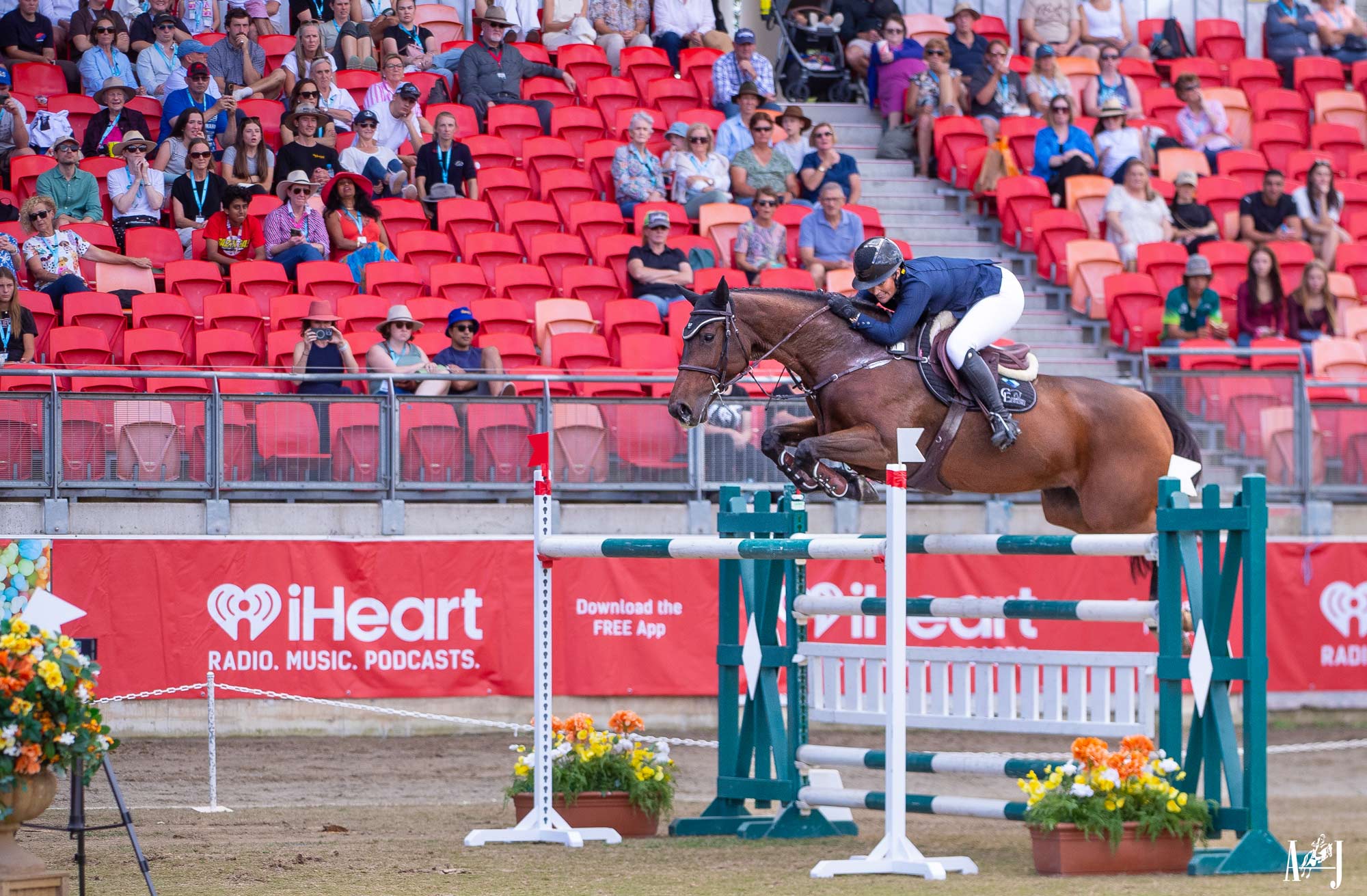
Sam Whale arrived in Australia with a clear plan, a lot of determination, and a deep love of the sport. A few short years on, she has built a life that blends high-level Jumping, family, and business, all grounded in the same grit and warmth that shaped her early years in New Zealand.
Now based in Goulburn, New South Wales, Sam has become a familiar and respected face on the Australian jumping circuit. Her journey, however, began far from a traditional horse family.
Advertisement
“I’m not actually from a horsey family at all,” Sam explains. “My dad took us to a handful of riding lessons when I was about five. But it was really when my stepmum came on the scene. She’d had horses in England and she was the one who started taking me to weekly riding lessons.”
That early encouragement quickly became something more. For her eighth birthday, Sam received her first pony, and by the age of twelve she had found her way into showjumping. From that point, there was no turning back.
Her father, while supportive, was far from comfortable around horses. “Dad was petrified of them,” Sam laughs. “The only thing he would help with was doing the studs because I was really good at cross-threading them. That usually meant paying for new shoes, but he stayed well away otherwise.”
A turning point came when Sam’s father found a pony for her tenth or eleventh birthday. It was far more horse than she needed at the time, but Sam was determined. She was desperate to compete at local Pony Club and dreamed of making the North Island Showjumping Championships team.
The pony, Cam, was barely 14.1 hands and bred for hack classes, but he rose to the challenge. “He had little pin legs and not much of him, and there I was jumping metre thirty-five tracks. I used to petrify my family, but that’s what I wanted to do.”
Advertisement
By her mid-teens, Sam was already working to support her riding. From the age of fourteen she worked at Cambridge Stud, walking across the road on weekends to help with feed-outs before progressing to school holidays, sales prep, and track work.
“That’s how I got into the thoroughbred side of things,” she says. “If I wanted to keep jumping, I had to make it happen.”
Her first hack was a thoroughbred she paid off weekly. “It was basically like a car loan, but for my first horse,” she says. “She was great but also terrible. She reared badly. We’d either get to the ring or we wouldn’t.”
That horse was still with Sam when she began a relationship with Jeremy. “He eventually said, ‘This horse has to go, I’m sorry.’ He was right.”
From there, Sam built her program the hard way. Buying horses off the track, producing them, selling some, and moving on to the next. Slowly, the quality improved.
Advertisement

Looking back, Sam describes the New Zealand Jumping scene as tight-knit and social. “It’s very similar in that everyone is really friendly,” she says. “Dannevirke Show was always one of our favourites. Big barbecue, everyone stayed up too late, and then you had to jump the next day.”
She remembers a particular night at Woodhill Sands. “There’s a photo of a few of us under a gazebo with one light in the middle. Everyone’s just silhouettes. We were singing. Nights like that don’t happen as much anymore, but they meant a lot.”
The idea of moving to Australia had been discussed for some time, largely driven by opportunity. Jeremy works in breaking in and pre-training thoroughbreds, and the Australian industry offered far more scope.
“I’m very stubborn,” Sam admits. “Once I get an idea in my head, I just make it happen.”
Originally, the plan was a six-week stint. “I just said it out loud. I had no idea how I’d get here, pay for it, or where I’d stay. But once you say it, you kind of have to do it.”
That leap was softened by good fortune. Through mutual connections, Sam was offered the chance to stay with Charlotte Inglis and her family while they were overseas. “I really fell on my feet,” Sam says. “I had an apartment at the stables, could bring three horses and the truck, and it’s turned into such a special friendship. Charlotte and Arthur are like my Australian parents now. Lexi feels more like a sister.”
Advertisement

From there, the move became permanent. After time at Capricorn Farm with Izzy Stone, an unexpected opportunity arose to go in on Lynton Farm in Goulburn. “One look at the video and I said we’d be silly not to,” Sam recalls. “It’s pretty amazing.”
Competition in Australia brought its own surprises. Sam laughs as she recalls her first Grand Prix start. “Back home, a Grand Prix is about 1.40. I entered the Waratah Warm-Up Grand Prix thinking it would be a nice lead-up to the World Cup. I stood at the gate and realised it was a full 1.50 track.”
Alone at the show and visibly nervous, Sam was steadied by a few quiet words from Aaron Hadlow. “He came up to me and said, ‘Just breathe.’ That meant everything.”
Sam went on to win the class. “It was just me and Aaron in the jump-off. I thanked him so much afterwards.”
The step up in height, she says, has ultimately built confidence. “When you’re jumping 1.50 or 1.55 regularly, World Cups don’t feel quite as intimidating.”
Sam had already jumped several World Cups in New Zealand before moving, all with the mare Fleur Delacour she affectionately calls the Dragon.
“She’s everything to me,” Sam says. “I’ve had her since she was three. I was an amateur rider, jumping maybe 1.25 when I bought her.”
Found on Trade Me and purchased after Sam sold saddles and horses to raise the money, the mare showed her quality early. “She won the four-year-old championship at Takapoto. Australians were trying to buy her and Jeremy and I nearly fought over it because I refused to sell.”
Producing the mare alongside raising two children was no small feat. “She’s exceeded every goal. Last year she jumped on a New Zealand team and won a round. She owes me nothing.”
The Dragon now has a young future ahead through her progeny, with a three-year-old filly embryo set to come into work later this year.
Alongside her is LP, a grey gelding whose stable name reflects his personality. “LP stands for Little Prick,” Sam says bluntly. “If you knew him, you’d understand.”
He was her Magic Millions partner this year, stepping up after a strong season. “He’s the hardest easy horse to ride. Extremely careful. If I don’t give the right direction, he’ll decide otherwise.”
Advertisement
Away from the arena, Sam has also launched a new business, The Horse Shop, focused on everyday stable essentials. “With Riley starting school, I wanted something of my own,” she says. “Online works with our life.”
The idea grew from helping international drafts during sales. “They can’t bring shampoo or hoof oil. I just asked what they needed and had it waiting.”
That initiative has now expanded to on-site retail at major sales, including the Inglis Classic Sales in February.
Looking ahead, Sam is honest about her goals. “I think I got a bit soft on the Dragon last year. I just want to look after her. But with LP, I have to ride every stride.”
Encouraged by close friends, including Chris Burton, Sam is determined to push herself further. “This year I want more fire in my belly. I want to really want the win.”
Championship teams remain an aspiration, but Sam is grounded. “I think we all dream of that. I’ve got the horsepower. When the time is right, it’ll happen.”
For riders considering a move across the Tasman, her advice is simple. “It’s never the perfect time. Just do it. Talk to people. Ask questions. It’s scary, but it’s exciting too.”
At her core, Sam believes her determination has always been there. She recalls cold-calling people as a teenager to find transport to shows. “If there’s a will, there’s a way.”
Asked how to keep people engaged in the sport, her answer is heartfelt. “Be kind. Everyone’s paying the same stabling fees. If someone looks stuck, offer help. Smile at the kids in ring three. It means a lot.”
It is advice that reflects the way Sam approaches her own journey. With generosity, resilience, and an unwavering belief in making things happen.
To hear the full interview with Sam listen to Episode 30 of the “All Clear” Podcast:
Advertisement