


Sarah McMillan: Built From the Ground Up

Above: Sarah McMillan and Everest JEP.
There is something quietly compelling about Sarah McMillan. The Central Coast horsewoman has spent years building her career with a patience and thoughtfulness. She competes at the top level of Australian Jumping, her partnership with Tyrone earning multiple World Cup qualifier wins and a reputation for consistent, considered performances. But to understand where Sarah is now, you have to go back to where she started, because almost everything about the way she approaches the sport today was shaped long before she ever stepped into a World Cup arena.
Advertisement
Sarah was born into a professional horse environment. Her father, John McMillan, had ridden alongside Rod Brown and George Sanna, and from those relationships a business partnership developed that would define Sarah’s early years. Growing up, there were anywhere from forty to sixty horses in work at any one time, horses in quarantine, horses being exported. It was a world of production and commerce, of serious horsemanship conducted at scale. For a small child watching all of this, it simply felt normal. John was initially reluctant to push Sarah toward riding, wanting to be certain her interest was genuine before investing in gear or ponies. Once he was satisfied her love was real, he became not just her father but her primary coach, and that relationship has remained the cornerstone of her career ever since.
John’s influence was never just about technique. He gave Sarah an understanding of responsibility from the very beginning. When she had a pony in work at six or seven years old, she was expected to ride it every day or every second day, regardless of whether she felt like it. The sport was never presented to her as a hobby, and she never experienced it that way. “It was a sense of responsibility and that’s just how it was,” she says. “And I loved it.” The ponies she rode were rarely the easy ones. John had a habit of putting her on the tricky horses, horses that were brave and safe but not straightforward, and Sarah reflects now on how much that shaped everything that came after “You don’t realise how much those horses really do shape your entire approach to the sport.”
Advertisement
The business reality of growing up in a horse dealing family also left its mark. Ponies were produced, improved, and sold on, with the profits reinvested into the next horse. Sarah knew that was the deal, and she accepted it, even when it was hard. She remembers being sat down in the truck at a show, alongside her parents and Jamie and Sue Coman, and being asked how she would feel about selling her pony Sky. She said she was okay with it, as long as she got to say goodbye. Her parents then told her it was already in quarantine. Sarah admits that now she finds selling horses genuinely difficult, particularly the older ones who carried her through juniors and young riders. Her father, for his part, insisted those horses be retired rather than sold on. “He said they looked after my daughter so we can look after them.” Several of them still live in the paddock at home.
Advertisement

Tyrone came into Sarah’s life under circumstances that were a little dramatic. Word came through a mutual friend that Des Russell, who had imported Tyrone as a two-year-old and then held equity in him alongside James Harvey, might be open to selling. Sarah was hesitant. She had recently come off the back of a horse purchase that had ended in heartbreak, a mare who had broken down after Sarah had invested deeply in her, and the experience had shaken her confidence in buying horses already competing at a high level. Tyrone, despite having the blood that she knew suited her, had an open front end and a ride she worried would not work for her free and open hand. Nonetheless, they drove to see him, crossing the Victorian border just hours before it was shut during COVID, Sarah pushing through a severe case of strep throat that should have had her in hospital. She rode him that afternoon, rode him again the next morning, and they committed to the purchase on Christmas Eve. He came home to Kulnura on New Year’s Day in 2021.
The early months were not easy. Sarah had to significantly change her ride, and she is candid that even now she is still learning what Tyrone needs and it was only eighteen months ago that she worked out he does not like front studs, regardless of the ground conditions, a discovery that took two and a half years to arrive at. That kind of patient listening, she says, is what any horse requires, no matter the level. What has emerged from that process, though, is something she describes simply as home. “He just, he’s home to me when I’m in the ring on him.” Over the past twelve months in particular, she feels she has truly unlocked his ride and management. In recent starts she cannot recall a single occasion where she has not thought he was on, a consistency she finds remarkable for a horse of his age.
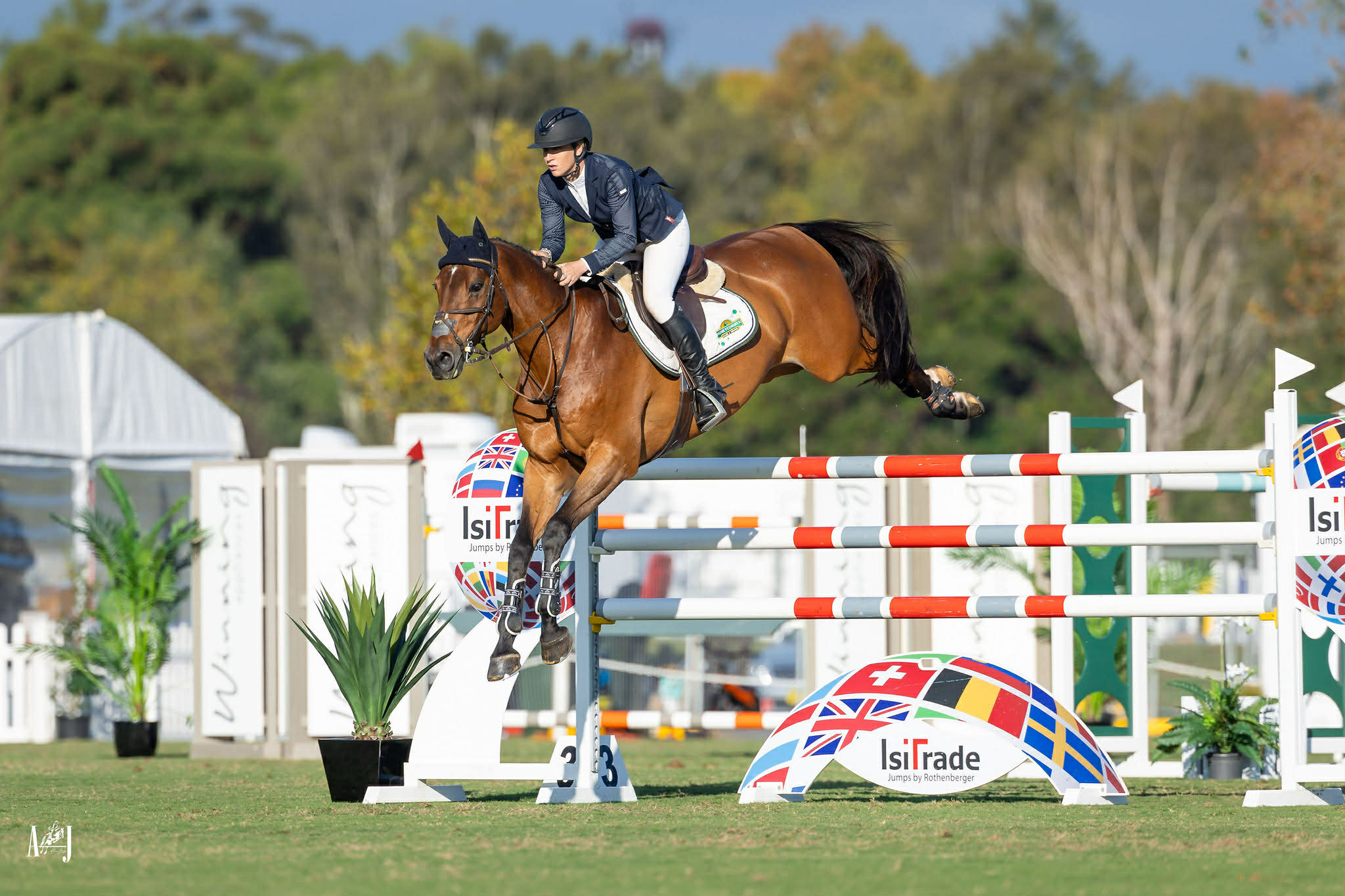
Above: Sarah McMillan and Tyrone. Photo Credit: Simon Scully Photography
Sarah manages Tyrone carefully now, rarely starting more than twice at any show, giving him a day or two off before a World Cup, and being selective about which classes he enters. Despite what the passport says, his physical condition continues to confound expectations. Trotting him on a hard circle, she says, he moves like a seven or eight year old. And his enthusiasm for the job has not dimmed in the slightest. At the Stonewall World Cup, which Sarah describes as the biggest class she has ever seen, Tyrone stood at the closed in-gate waiting to go and simply could not contain himself. “He just wanted to get in there and do his job,” she says. “And it made me really emotional before I’d even started.”
Advertisement
Sarah won her first World Cup qualifier for 2026 at Shepparton, and the emotion of that win carried more weight than most because her mum was not there to see it. Sarah lost her mum last year, and it sits at the centre of everything in her life right now. Her mum, by Sarah’s account, was the one who truly ran the show. John likes to think he ruled the roost, Sarah says with a warmth that makes it clear she found this endearing. But her mother was the one at the stables every day, lunging the horses, washing them, managing the feed and supplements programs, organising everything that needed to happen to keep the operation running. “She ran the whole show,” Sarah says. Filling those shoes since losing her has been hard in ways she did not anticipate, small practical things that her mother simply knew and Sarah is now working out for herself. The win at Shepparton this season, the first World Cup of the season, brought all of that to the surface. “She just would’ve been so thrilled.” It was emotional, she says, for two reasons: grief that her mother was not there, and genuine pride in the team that had held together through a very difficult year, including Millie, who has been helping Sarah run the stables throughout. “To be able to get a win after the past twelve months we’ve had, it was something we can be really proud of as a team.”
Away from Tyrone, Sarah’s stable reflects her philosophy clearly, with the way she takes a long view with her young horses. After university, Sarah and her parents agreed that putting all their eggs in one basket with a single horse was not the right approach, and they went out and purchased several two and three year olds. Two of those, Kakadu and Everest, have become what she calls her mates and teammates, polar opposites in personality but both progressing through the grades.
Advertisement
When Sarah talks about goals, she is careful and considered. She tries not to set specific ones, at least not in the conventional sense, because she has found that goals can shift focus away from the horse and toward the rider’s own ambitions or ego. If a horse throws a splint, or a show gets cancelled, a rigid goal becomes an obstacle to doing the right thing. Instead she works by feel, by instinct, by a loose sense of where each horse is heading rather than a fixed destination. She has dreams, of course. Every rider’s dream, she says, is to have an Australian flag on their jacket. But if that does not happen, it does not mean failure. The goal she returns to most readily is simpler and more durable than any selection result: to be a respected rider, at home and internationally, seen as a genuine competitor. “That’s a dream you can work towards every day,” she says.
If there is a thread running through everything Sarah McMillan says, it is this: the sport rewards those who listen. Listen to the horse, listen to the process, listen to experience, and ask more questions than you think you need to.
There was so much more to the All Clear Podcast episode we recorded with Sarah and we think you will love it. Episode 47 is available on:
YouTube: https://bit.ly/4uoXdC7
Spotify: https://bit.ly/4u7Eb3D
Apple Podcasts: https://bit.ly/4tRIrnF
Advertisement