


Rebecca Henry: Station Life, Course Design, and the Long Road from Far North Queensland
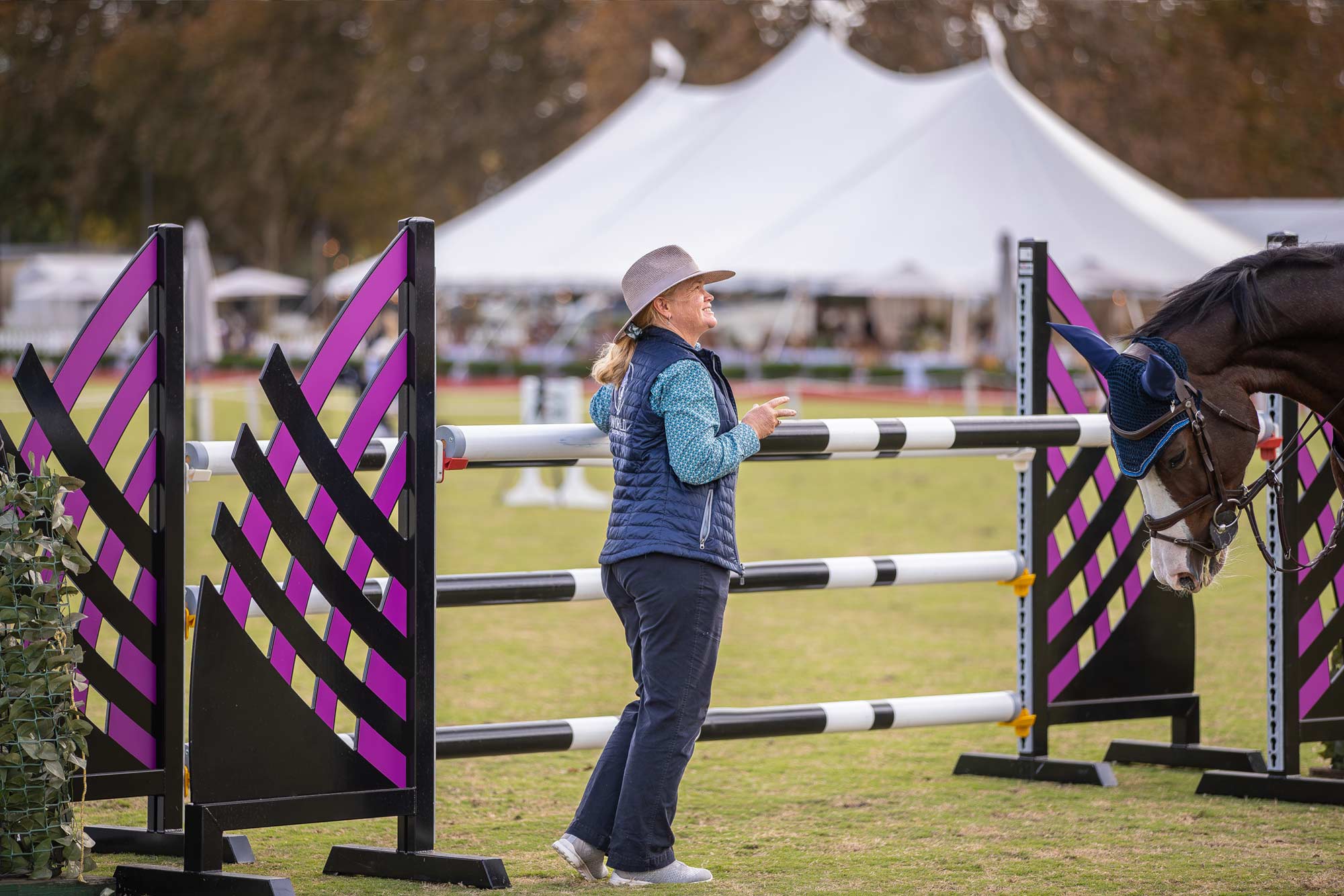
There are not many people who can say they start their day at four-thirty in the morning with a coffee and a set of accounts, spend the daylight hours checking cattle and fixing fences across 18,000 hectares of far north Queensland, and then fit in riding horses before an early night so they can do it all again tomorrow. Rebecca Henry does exactly that, and somehow alongside all of it, she has built a career as a respected course designer working at the highest levels of the sport, both in Australia and internationally.
Advertisement

Bec grew up between two properties, one at Innisvale on the coast and one at Sugar Bag Station, which sits about three hours southwest of Cairns. Her childhood was shaped by the rhythms of rural life, riding around cane paddocks, down to the creek, and out among the cattle, rather than by formal riding lessons or pony club schedules. Her first horse was a Shetland with a character all of his own, a horse she remembers with genuine fondness as one that sometimes had other ideas about where they were going. From there she moved onto bigger horses quickly, and it was not long before jumping entered the picture. Her father and aunt had competed at local shows when they were young, riding into town to jump, and Bec believes that thread of influence was always quietly there. The real turning point came when she was twelve years old, at a North Queensland Showjumping Club, riding a little mare called Wakey. She says that from that day she was completely hooked and never did anything else.
Advertisement
The northern show run was a formative environment for her development as a rider. Bec describes it as strong and fast, where winning at Cairns or on the local show run meant you could travel south to Brisbane and Caboolture and hold your own. Her father became president of the North Queensland Showjumping Club and was a genuine supporter of getting the sport going in the region. Through those years, Young Riders trips were organised, with teams drawn from North Queensland competing alongside riders from New Zealand, Southeast Queensland, and New South Wales, all on borrowed horses at shows across Caboolture, Brisbane Royal and Nambour. Bec looks back on those years as a really good time to be involved in the sport.
Despite competing to World Cup level, Bec reflects honestly on the fact that she often doubted herself during her riding career. She attributes some of that to the remoteness of where she lives and the difficulty of accessing regular coaching and clinics. She would make at least three trips a year to Sydney, Melbourne, and Brisbane to find riders who would share their knowledge with her. One of the most significant moments she recalls is a lesson with Michelle Lang at Toowoomba, where she was riding a horse called Farmer Jacob. Lang told her that Jacob would jump World Cup for her one day, and Bec describes that kind of belief from another person as exactly what she needed. It is also the kind of rider she now wants to be for the young people she coaches.
Advertisement

Her string of horses over the years tells a story of someone with a genuine eye for talent and a willingness to take on difficult rides. Wakey came first, that small stock mare who could clear a fence well above what her size suggested. Simply Irish was her first true Grand Prix horse, and she is candid about the mistakes she made on him as she was learning to hold a horse together and stay on the correct stride. Farmer Jacob came off the local racetrack and was taken all the way through to World Cup level. And then there was Spielberg, a horse she describes as a rockstar with enormous scope, sourced from Tim Clarke. It was with Spielberg that she competed at World Cup, jumping what she remembers as one of only two clear rounds at Brisbane Royal before the Equine Influenza (EI) outbreak brought everything to a halt. During the shutdown that followed, she lost Spielberg very suddenly. That loss, she says, was a significant catalyst for what came next.
The period after EI prompted Bec to reconsider the direction of her life in the sport. She still had horses capable of competing at the one-forty level and above, but something had shifted. She made the decision to travel to the other side of the country and enroll at Marcus Oldham College in Victoria on an equine sports scholarship. She spent two years there, first attempting to combine competing with studying before sending her horses home and focusing entirely on her studies. She came away with a Diploma of Horse Business Management and a degree in busines. It is the kind of achievement that reveals something about the way she approaches everything she does: she wanted to learn as much as she possibly could, and a pass was not going to be enough.
When she returned to far north Queensland, coaching was the next chapter. She formalised her accreditation and worked her way through to a level two jumping specialist coaching qualification. Around the same time, she noticed that the sport in North Queensland was being held back by a shortage of officials. With only around three officials in the entire region, events were struggling to be covered. So she went and got her qualifications in judging and course designing, initially just to help keep local competition going. She still sounds slightly amazed at where that decision has taken her.
Advertisement

The evolution from local official to internationally respected course designer happened through a series of connections and invitations, each one leading to the next. Brad Longhurst invited her to Summer Classic after she met him at Gatton Show, which led to Canberra, which led to Sale. A moment she identifies as a genuine turning point came when Edwena Mitchell brought Olaf Petersen Jr. across to the Australian Championships. Bec had been at a point where she was considering stepping back from course design altogether, feeling that it might have run its course for her. Meeting Olaf and watching him work changed everything. Something as subtle as shifting a pole or changing an angle opened up a completely new level of understanding for her. She was subsequently invited to work with him at Munster in Germany and then at Saugerties in the United States, and she describes that as opening the floodgates.
More recently she was invited to Ocala in Florida by Bernardo Costa Cabral, where she worked on a five-star World Cup qualifier under lights. She is thoughtful about what those international experiences have actually taught her, noting that far from making her feel that Australian jumping is behind, they have reinforced her confidence in the fundamentals. Jumping is jumping, she says, no matter where you are in the world. She also notes that the scale of international competition exists partly because of the concentration of top riders in one place, and she mentions seeing two Australians in the World Cup Qualifier field in Ocala as something that stood out to her.
Her philosophy as a course designer is straightforward and genuinely held: she wants every horse and every rider to come out of the arena with their confidence intact. She is not there to frighten anyone. She talks about footing and distances as interconnected, explaining that good footing opens up a horse’s stride and that distances need to reflect that. She thinks carefully about construction, about where a stripe pole or a coloured pole is placed, about where a gate or a plank sits in a fence, and how each of those decisions affects whether a horse can clearly see the top rail and jump with confidence. At the higher levels she will bring distances in to test the riders, but at the lower levels the distances should, in her words, be sweet all the time.
Advertisement
The social licence question sits close to the surface of the way she talks about the sport. Everyone has a phone, she says, and one bad round is what people will see. She takes seriously the responsibility that comes with designing courses in an era when any moment can be captured and shared instantly. One of her most satisfying experiences was watching the tracks at the FEI Asian Championships in Thailand, where she felt the course design served every horse well, regardless of the spread of levels in the field. The horses looked happy, the competition produced the right result, and the horses that were well educated and jumping off rhythm were the ones that came through.
Beyond the course design, Bec is also part of Queensland Off the Track’s Acknowledge Retrain program, which she applied for when it was released around 2022. She has had up to twenty-five horses at a time going through the process of coming off the track and being prepared for new careers, though the growth of her course design work has meant she has reduced those numbers. Her approach to retraining is patient and unhurried. Horses arrive, go into individual paddocks to settle and decompress, then move into larger paddocks with other horses once they are ready. The social environment of a group of horses in fifty or sixty acres does a great deal of the work, she says. When the time is right, she starts them with soft, gentle rides and lets the process unfold naturally.
Advertisement
She coaches a small group of riders in far north Queensland and genuinely loves seeing young people take a horse off the track and bring it through. She mentions a young girl not far from the station who has taken an off-the-track thoroughbred all the way to 1.20m, and you can hear the warmth in the way she talks about it.
Running Sugar Bag Station has recently become a larger responsibility, with her parents having retired and Bec taking over the full operation. The driveway alone is nine kilometres long, and the property sits thirty kilometres outside of Mount Garnett, a small town with a post office and, as she notes with dry humour, not even a pub anymore. She is up at four-thirty every morning to get through the bookwork before the sun rises, then it is feeding the horses, then the cattle work, then riding in the afternoon before an early night. She acknowledges that she has thought more than once about moving to Sydney to make the sport easier to pursue, but something about the quietness of the station and the freedom it offers keeps drawing her back. The ride-out alone, across dams and for kilometres in every direction, is something she considers one of the biggest drawcards of her life there.
Advertisement
Her goals from here are shaped by the same understated ambition that seems to characterise the way she has approached everything. She wants to keep giving back to local and grassroots competition and would like to continue pursuing opportunities in the United States and to keep moving up through the levels in Australian sport. She is currently FEI Level Two and says she would love to reach FEI Level Three, though she is not obsessed about it.
Her advice to young riders growing up in remote areas is grounded and practical: work your horses honestly, get to bigger shows whenever you can so you can see how good riders train their young horses, stay true to the fundamentals, and be brave enough to ask better riders for help. She believes the sport encourages sharing, and that most people, when asked, will give something back. It is the kind of advice that comes from someone who had to find her own way and who genuinely wants the path to be a little easier for the people coming behind her.
You can find the full interview with Rebecca on the All Clear Podcast available now on YouTube, Spotify and Apple Podcasts.
You Tube: https://bit.ly/3PDcSP8
Spotify: https://bit.ly/4bFOVzm
Apple Podcasts: https://bit.ly/4lW3DWt
Advertisement